
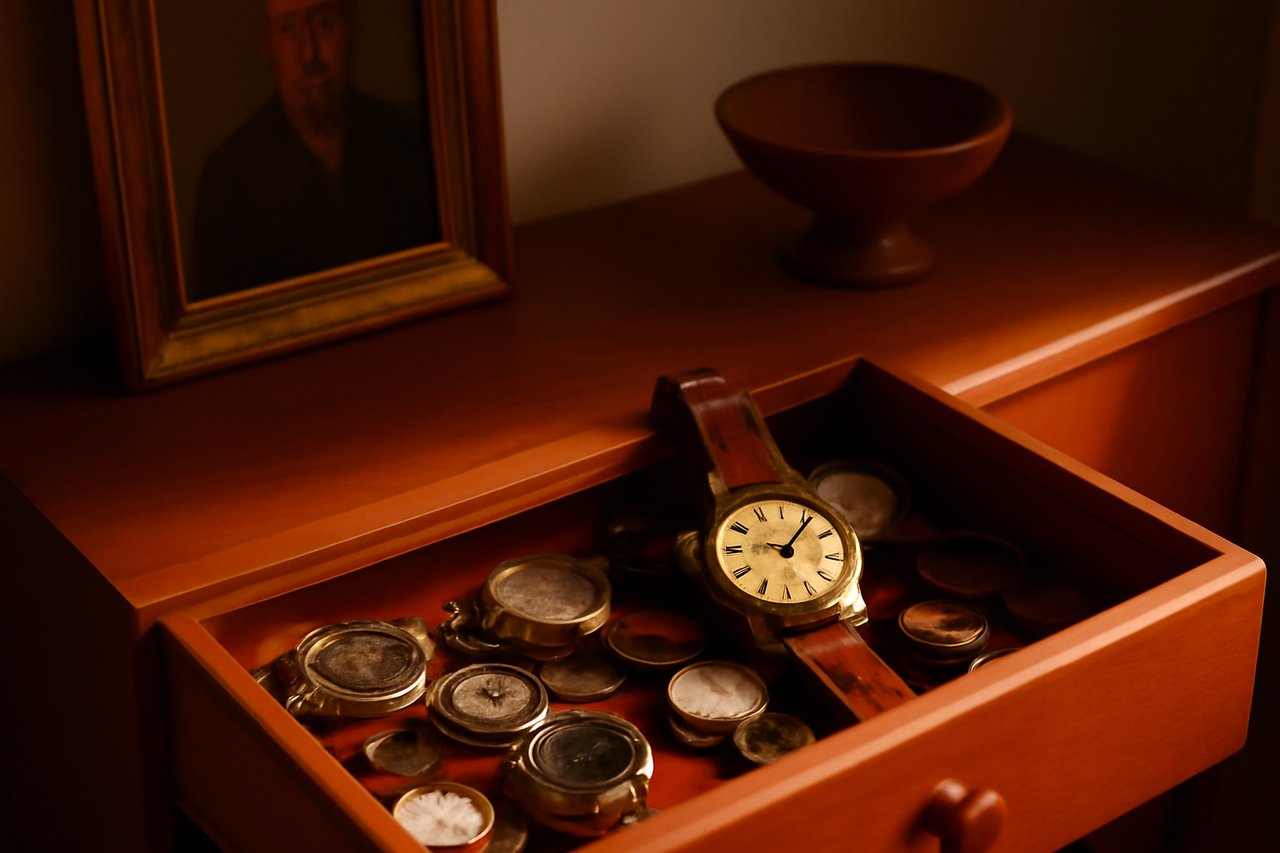
The Watch Drawer Problem
Almost every estate has one. A dresser drawer, a box on the nightstand, or a velvet-lined case holding anywhere from two to fifteen watches. Some are department store quartz pieces from the 1990s. Others might be serious vintage timepieces that collectors actively hunt.
The hard part is that they can look almost identical to an untrained eye.
Here's what actually separates a watch worth $50 from one worth $5,000.
Start With the Movement Type
Flip the watch over. Some cases have a transparent caseback that lets you see the movement inside. Others are solid.
For now, the simplest sorting question is: is this mechanical or quartz?
- Mechanical watches (hand-wound or automatic) have no battery. They tick with a sweeping motion. These are where vintage value almost always lives.
- Quartz watches run on a battery and tick once per second. Most are everyday consumer items, with some notable exceptions like early digital watches or certain Omega and Rolex quartz models.
If a watch takes a battery, set it aside for now. If it's mechanical, keep looking.
Brands That Consistently Carry Value
Not all mechanical watches are valuable, but certain names matter significantly:
- Rolex, Omega, Patek Philippe, Cartier, IWC, Jaeger-LeCoultre
- Vintage American brands: Hamilton, Elgin, Waltham, Illinois
- Mid-century Swiss: Longines, Universal Geneve, Zenith, Movado
- Early Seiko and Citizen models from the 1960s and 1970s
A brand name alone doesn't guarantee value, but it tells you to look further before making any decisions.
What to Check on the Dial
The dial (the face) is one of the biggest value drivers in vintage watches. Look for:
- Original, unrestored dials. Refinished dials significantly reduce collector value.
- Unusual or rare configurations. Chronograph functions, multiple time zones, moon phase displays.
- Condition. Surface scratches on the crystal matter less than condition of the dial itself.
- Signatures. Some dials are signed by jewelers or retailers (Tiffany, Cartier) which can multiply value.
A Note on Paperwork and Boxes
Original box and papers (sometimes called "full set" or "B&P") can add 30 to 50 percent to a watch's value. Check everywhere for documentation, receipts, or original packaging before selling.
What Often Gets Overlooked
Military watches are systematically undervalued by people who don't collect them. A plain-looking tool watch with military markings on the caseback, like a broad arrow or service numbers, can be worth multiples of what it appears.
Ladies' watches also get dismissed too quickly. Small gold watches from the 1940s and 1950s, particularly from Swiss makers, have strong collector markets.
When to Get a Closer Look
If you've found something mechanical, from a known brand, with an original dial and no obvious damage, don't price it for a garage sale yet. A photo-based identification tool like Tappraise can match it against comparable sold examples quickly, giving you a realistic sense of market value before you decide what to do with it.
A five-minute check before selling could be worth several hundred dollars on the right watch. That's a reasonable use of five minutes.