
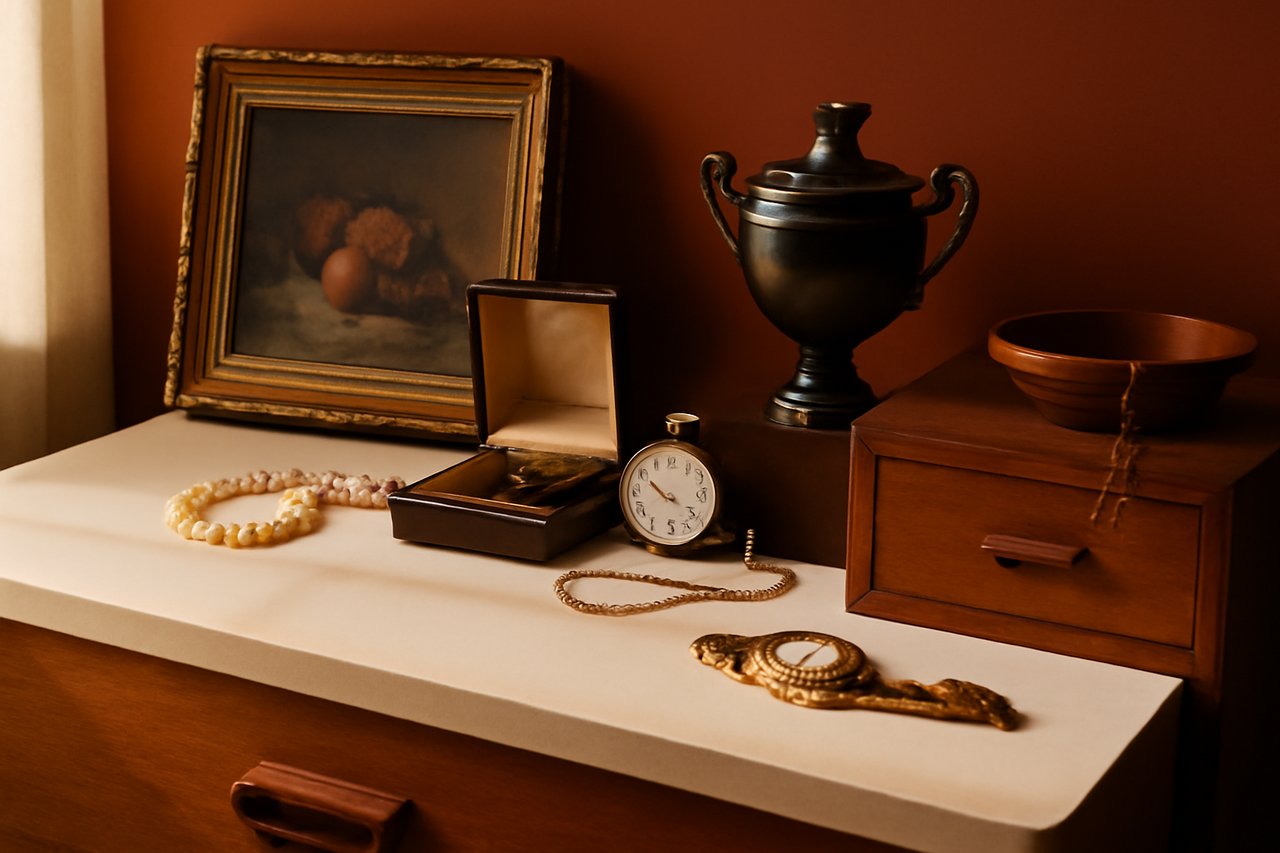
A Jewelry Box Is Not a Safe
Most people treat inherited jewelry as if everything in it is valuable. Some of it is. Some of it is costume jewelry worth a few dollars. Some of it is fine jewelry that should be appraised before you accept any offer. The challenge is that it all looks the same in a velvet-lined box.
A little basic knowledge lets you sort quickly and make better decisions about what to sell, what to keep, and what to get properly valued.
Start With Metal
The metal content of a piece sets a floor value independent of design or age.
Gold is marked with a karat stamp: 10K, 14K, 18K, or 750 (which means 75% gold, the European equivalent of 18K). These stamps are usually inside a ring band, on a clasp, or near the hinge of a locket. Gold holds value and is always worth something, even if the design is unfashionable.
Sterling silver is marked 925 or "Sterling." It has scrap value but modest collector value unless it is from a known maker.
Platinum is marked Pt, Plat, or 950. It is dense, heavy for its size, and valuable.
Gold-filled and gold-plated pieces are marked GF, RGP, or similar. They have minimal metal value.
If you see no mark at all, assume costume until proven otherwise.
Then Look at Stones
Diamond, ruby, emerald, and sapphire set in gold or platinum are worth professional attention. Period. Do not guess, and do not sell these quickly to the first buyer who approaches you.
Semi-precious stones like amethyst, topaz, and garnets have some value but rarely drive the price of a piece the way diamonds do.
Beware of pieces with large, very clear, perfectly matched colored stones in older settings. Real gemstones of that quality are expensive. If the stones look too perfect, they may be glass or synthetic, which does not make the piece worthless but changes the math significantly.
Signed Pieces Are a Different Category
Costume jewelry from certain makers can be worth more than plain gold. Pieces signed by Miriam Haskell, Trifari, Schreiner, Weiss, or Eisenberg have a real collector market. Mid-century Scandinavian silver from makers like Georg Jensen commands strong prices.
Flip every piece over before you decide it is worthless. A signature or hallmark on the back changes the conversation entirely.
Watches Deserve Their Own Moment
Do not lump watches in with jewelry and make decisions in bulk. A vintage mechanical watch, especially from Rolex, Omega, Longines, Patek Philippe, or IWC, deserves individual research even if it is not running.
Condition matters a lot, but a non-working vintage watch from a major maker can still be worth hundreds or thousands of dollars. Check the dial, case back, and crown for markings before you make any assumptions.
Where to Sell
Your options, roughly in order of effort versus return:
- Online marketplaces (eBay, Etsy for vintage, Tappraise) give you access to collectors willing to pay fair prices, but require photos and descriptions
- Estate jewelry dealers offer convenience but typically pay 30 to 50 percent of retail
- Auction houses work well for significant pieces with clear provenance
- Scrap buyers make sense only for damaged or unmarked gold with no design value
Knowing roughly what you have before you walk into any negotiation is the only real protection you have against a low offer.
One Practical Step
Photo every piece in good light before you sort them. An image captures the marks, the condition, and the design in a way your memory will not. From there, identification tools and a little research go a long way toward knowing what you actually have.